Blog / Small Business Automation
Automation Freelancer, Agency or In-House Hire: How to Choose
By Keyona Meeks, Founder, ReRev Labs · Oct 31, 2026 · 9 min read
The short answer: Choose by the shape of the work. A defined piece with an end point suits a freelancer or a small build team. A set of connected systems that need several skills suits an agency. A steady stream of changing work that touches daily operations is the case for an in-house hire. Whichever you pick, three things matter more than the label: the work lives in your accounts, someone can explain it in plain words, and you know who fixes it when it breaks. We sell build work, so weigh this with that in mind. This is my judgment. I have no data on which option works best.
By the end of this post, you'll be able to:
- Describe the three options by what each one is good at.
- Match your situation to one of them.
- Ask the questions that expose a bad fit before you sign.
- Insist on the three things that protect you.
We sell build work, and I want that said up front. The comparison below is my judgment, not research. Where I rely on a source, I name it.
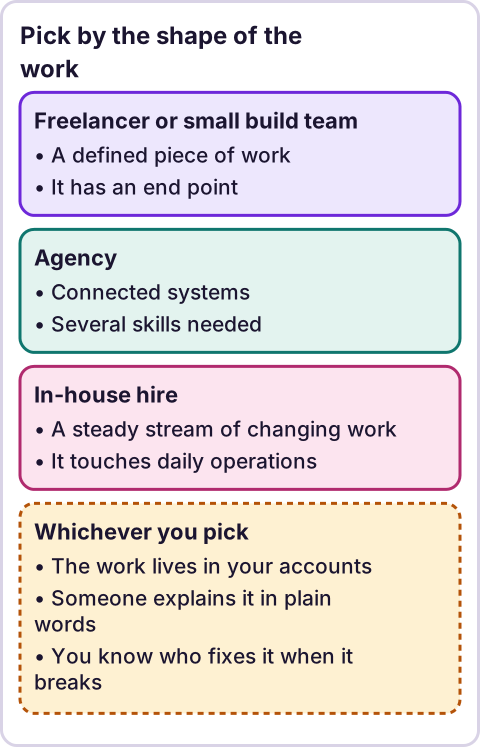
Diagram: Pick by the shape of the work.
What are the three options?
- A freelancer. One person, hired for a defined job or a few hours a month. You deal with them directly.
- An agency. A team that sells a service. You may talk to a salesperson, a project lead and the people who build.
- An in-house hire. Someone on your payroll whose job includes building and keeping up your automations.
A fourth path, doing it yourself with an AI assistant, is real. It is the right answer for small, low-risk jobs, and I leave it out here because the question is about hiring.
How do the three compare?
This table is my judgment, not a standard.
| Freelancer | Agency | In-house hire | |
|---|---|---|---|
| Good for | A defined piece with an end | Several connected systems, several skills | Steady, changing, daily work |
| Strength | Direct, flexible, focused | Depth and a bench if one person is out | Knows your business and is there when it breaks |
| Watch for | One person is a single point of failure | Layers between you and the builder | Needs enough work to stay busy, and a manager who can judge it |
| Ends when | The job is done | The contract ends | The hire leaves |
None of them is better in general. The question is which one matches your work.
Which one fits your situation?
Answer these. They are mine, not a validated test.
- Can you describe the finished thing in two sentences? If yes, a freelancer or a small build team can usually take it.
- Does it connect four or five tools and need design, data and testing skills? An agency or a team may fit better than one person.
- Will there be new automation work every week, indefinitely? That starts to look like a job.
- Is the work touching money, customer data or anything regulated? Ask your attorney and your insurer what you must control before anyone builds it.
- Can you judge whether the work is good? If nobody on your side can, the person you hire becomes the only judge. Plan for that.
If you cannot answer the first question, start with a short scoping step before you pick a vendor. Our post on what to automate first is a way to choose that first task.
What protects you whichever option you pick?
Three things.
1. It lives in your accounts. This matters more than people expect. For Google's Apps Script, the documentation on installable triggers says they "always run under the account of the person who created them." I checked that line in an earlier review, and it applies to scripts you run on a schedule. If a freelancer builds a scheduled script in their own account, it runs as them. When they leave, the work can stop or disappear. Ask where it will live, and have it set up in an account you own.
2. It is explained in plain words. Ask for a short document that says what it does, what it connects to, where the settings are and how to tell it is working. If the builder cannot write that, they probably cannot support it either.
3. You know who fixes it. Tools change. Passwords expire. Ask who you call, how fast they answer, and whether fixes are included or billed separately. Get the answer in writing.
What should you ask a freelancer or an agency?
- Can you show me something similar that works? A real example beats a pitch.
- What does done look like? Ask for a test you can run yourself.
- Whose accounts will it run in?
- What do you need from me, and when? Delays often come from the client side.
- What happens when something breaks after you leave?
- What will you not do? A clear no is a good sign.
If the answers are vague, that tells you something.
What should you ask before hiring in-house?
- Is there enough steady work? A builder with nothing to build becomes a maintenance person.
- Who will judge their work? If nobody can, you are trusting by default.
- What if they leave? The three protections above matter most here, because one person holds everything.
- Is some of the work better done once by someone outside and then handed over? Often it is.
How much will it cost?
I cannot tell you, and I will not guess here. Prices vary by scope and by who you hire. For general ground on cost, see our post how much small business automation costs. Ask each vendor what is included, what is extra and what the ongoing costs are. Compare the answers line by line.
What do we offer?
Our site describes a build sprint as connecting your tech stack, then building and testing each system on your real data, with the systems living in your own accounts after handover. It is one option among the three above, closest to a small build team. If your work is a defined task that touches tools you already pay for, tell us what it is and we will talk through whether it fits. If a freelancer or an in-house hire fits better, that is a fair answer too.
Where does an LLM fit in this?
An LLM can help you write the brief: turning a rambling description of the problem into a clear scope, a list of tools and a definition of done. It can also help you read a proposal and list the questions it leaves open. A person should decide, because an LLM does not know your risk tolerance or your history with a vendor. My stance: AI writes the code, plain automation runs it, and an LLM shows up only where the input is messy and a person checks the result.
Where this has limits
- This is a judgment piece. The table and the questions are mine, not research.
- I have no data on which option is cheaper, faster or more reliable.
- We sell build work. I tried to keep the comparison fair. Read it with that in mind.
- The trigger line is from an earlier review. Check the live Google page.
- Regulated work needs more. Ask your attorney and your insurer before you hand over anything that touches money, customer data or compliance.
- No ReRev prices and no promises about results.
Frequently asked questions
Should I hire a freelancer or an agency to automate my business?
It depends on the shape of the work. A defined piece with an end often suits a freelancer or a small team. Several connected systems may suit an agency.
When does an in-house hire make sense?
When there is steady, changing automation work and someone on your side can judge it.
What should I make sure of, whoever I hire?
That the work lives in your accounts, that it is explained in plain words, and that you know who fixes it.
Why does it matter whose account a script runs in?
Google says installable triggers run under the account of the person who created them, so a script built in someone else's account can stop when they leave.
What does a build sprint include?
Our site describes it as connecting your tech stack, building and testing each system on your real data, and leaving the systems in your own accounts after handover. Tell us what you need and we will talk it through.
Can I do it myself with AI?
For small, low-risk jobs, often yes. This post is about hiring.
Read next: When to hire someone to automate a workflow for the hire-or-not decision first, and hiring a Google Apps Script developer if a freelancer for small builds is the route you pick.