Blog / AI & Automation
How to Get AI Assistants to Mention and Cite Your Business
By Keyona Meeks, Founder, ReRev Labs · Oct 31, 2026 · 10 min read
The short answer: Nobody can make an AI assistant mention your business, and anyone who promises it is guessing. What you can do is meet the published conditions. Google says a page must be indexed and eligible to show in Search with a snippet, and that no special files or markup are needed. OpenAI says to allow its search crawler, OAI-SearchBot, in robots.txt. After that, publish plain, specific pages that answer real customer questions, then check once a month what assistants say about you and fix wrong facts at the source. Even then, Google states that "Indexing and serving aren't guaranteed."
By the end of this post, you'll be able to:
- Say what Google and OpenAI publish about appearing in AI answers.
- Check your robots.txt for the crawlers that matter.
- Write pages an assistant can read and quote.
- Keep a monthly log of what assistants say about your business.
We sell Pixels, which are interactive micro-tools for websites, so weigh this post with that in mind.
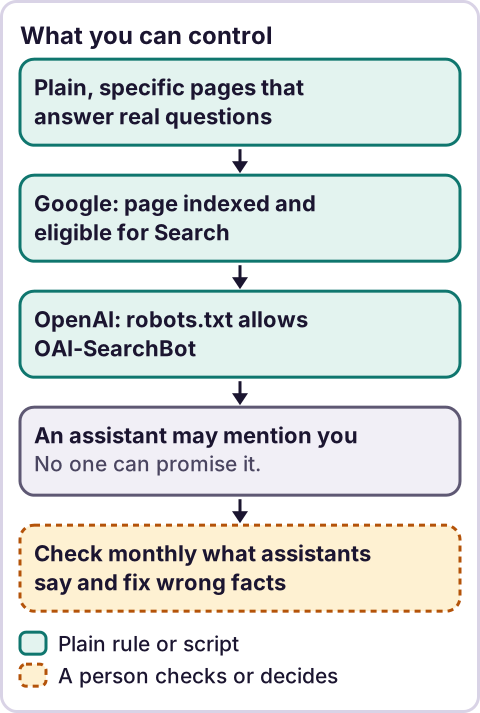
Diagram: What you can control.
Can you pay or tweak your way into an AI answer?
No. The vendors publish conditions, not a way to buy a place. Google's guide on its generative AI features says: "Indexing and serving aren't guaranteed." It adds that meeting all the requirements does not mean Google will crawl, index or serve your content. I give no ranking promise and no citation promise in this post, and you should be wary of anyone who does.
What does Google say you need?
I read two Google pages on October 31, 2026. My tool returned the full text of both, but it passed me quotes through a summary step, so check the quotes on the pages.
- AI features and your website (page dated December 10, 2025): "There are no additional requirements to appear in AI Overviews or AI Mode, nor other special optimizations necessary." A page "must be indexed and eligible to be shown in Google Search with a snippet."
- Optimizing for generative AI search (page dated July 10, 2026): "Create the content yourself based on what you know about the topic." It says to "focus on what your visitors would enjoy, find helpful, and feel satisfied with after visiting your website." It says Google's generative AI models use "publicly accessible, crawlable content."
On files and markup, the guide says: "You don't need to create new machine readable files, AI text files, markup, or Markdown to appear in Google Search." On structured data it says: "Structured data isn't required for generative AI search, and there's no special schema.org markup you need to add." The other Google page says to make sure structured data matches the visible text on the page.
What does OpenAI say you need?
I read OpenAI's bots page on October 31, 2026. It lists three crawlers.
- OAI-SearchBot. The page says it "is used to surface websites in search results in ChatGPT's search features." It recommends allowing it in your robots.txt file. It also says "Sites that are opted out of OAI-SearchBot will not be shown in ChatGPT search answers" and can still appear as navigational links.
- GPTBot. The page says it "is used to make our generative AI foundation models more useful and safe," and that disallowing it "indicates a site's content should not be used in training generative AI foundation models." Whether to allow it is your decision.
- ChatGPT-User. The page says it is used "for certain user actions in ChatGPT and Custom GPTs" and that robots.txt rules may not apply, because a user starts those actions.
I did not read the documentation of other AI vendors for this post. Check each one you care about.
How do you check your robots.txt?
- Open
yourdomain.com/robots.txtin a browser. Replace the first part with your own domain. - Look for lines that name
OAI-SearchBot,GPTBotorGooglebot. Look at the lines under each name. - A line that says
Disallow: /under a name blocks that crawler from the whole site. A line underUser-agent: *can block crawlers that have no section of their own. - If you see something you did not choose, ask whoever runs your site. Do not guess.
I did not read the robots.txt standard for this post, so I do not explain how groups combine. Your web person should check the rules. Some site builders and hosts add robots rules for you, so look even if you never wrote the file.
How do you write pages an assistant can use?
This part is my judgment, not a vendor rule. It follows the principle in Google's guide: write for the visitor.
- Say who you are, where you work and what you do, in plain words. Put it on the page as text.
- Answer the question near the top. Use a question as the heading and a short answer under it.
- Be specific. Name the service, the place, the process and the limits. Vague pages give an assistant little to quote.
- Write what only you know. Your own process, your own examples, your own numbers if you have measured them. Google's guide says to create the content yourself from what you know.
- Keep facts the same everywhere. Your site, your profiles and your listings should agree on name, address, services and hours.
- Date your pages and name the author. A reader can then judge how current it is.
- Keep the text in the page. If the words only appear after a script runs, a crawler may not see them. I did not test how each crawler reads script-built pages. For a Lovable site, see making your Lovable website AI-crawler friendly.
What about llms.txt and special files?
Google's guide says you do not need them to appear in Google Search, and that Google Search does not use them. It says creating them for other services is fine and will not help or harm your Google visibility. I did not find a statement from OpenAI on them in the bots page I read. If someone sells you a file as the fix, ask which assistant's own documentation says it reads that file.
How do you check what assistants say about you?
Once a month, ask the assistants your customers might use five questions they might ask. For example: "Who does [your service] in [your city]?" and "What does [your business] do?" Record each answer in a sheet with these columns:
| Column | What you record |
|---|---|
| Date | The day you asked |
| Assistant | Which one, and which mode |
| Question | The exact words |
| Mentioned? | Yes or No |
| Accurate? | Yes, No or Partly |
| Link shown | The page it pointed to, if any |
| Fix | What you will change on your site |
Answers can differ from person to person and from day to day, so one check proves little. Look for patterns over months. When an answer is wrong about your business, fix the fact on your own page first. I cannot promise a fix changes the answer.
Where does an LLM fit in this?
An LLM fits in two places. It can draft the list of customer questions from your service pages, and it can summarize your monthly log into a few lines. A person checks both, because a model can invent a question nobody asks or misread an answer. Asking an assistant what it knows about you is also a useful mirror. It is not proof of what other assistants say. The checks themselves, robots.txt and the log, are plain steps. My stance: AI writes the code, plain automation runs it, and an LLM shows up only where the input is messy and a person checks the result.
What can a Pixel do here?
A Pixel is a small interactive tool, such as a calculator, a quiz or a workflow map. Our Pixels page describes them as tools that help your audience with a specific problem. A useful tool is one kind of original content, and it gives people a reason to visit and link. It does not give a ranking or a citation. If the tool is built with script, put the explanation, the method and the main answer in plain text on the page too.
Where this has limits
- No one can promise a mention. Google says indexing and serving are not guaranteed.
- My tool passed me quotes through a summary step. Check the quotes on the vendor pages.
- I read Google and OpenAI pages only. I did not read other vendors' rules.
- The writing tips are my judgment, not vendor rules, and I have no measured results for them.
- I did not read the robots.txt standard. Ask your web person about the rules.
- Pages change. The dates above are when I read them.
- No ReRev prices and no promises about results.
If you want help with a useful tool on your site, see our Pixels service or tell us your customers' main question. We sell this work. Do not send passwords or keys.
Frequently asked questions
How do I get ChatGPT to mention my business?
You cannot make it. OpenAI says to allow OAI-SearchBot in robots.txt so your site can appear in ChatGPT search answers. Publish clear pages and check the log monthly.
Do I need an llms.txt file?
Google says you do not need one to appear in Google Search. I found no statement from OpenAI on it in the page I read.
Do I need special schema markup?
Google says structured data is not required for its generative AI features. It says any structured data should match the visible text on the page.
Should I block GPTBot?
That is your decision. OpenAI says disallowing GPTBot indicates your content should not be used to train its foundation models. OAI-SearchBot is the one for search results.
How do I know if an assistant mentions my business?
Ask it, record the answers monthly and look for patterns. One answer proves little.
Can an agency guarantee citations?
No one can, as far as I know. Google states that indexing and serving are not guaranteed.
Read next: Is a Lovable website good for SEO? covers the crawlability fix that has to work before any assistant can cite you.