Blog / AI & Automation
What It Costs to Run an AI Agent Every Month vs. a Script
By Keyona Meeks, Founder, ReRev Labs · Oct 31, 2026 · 9 min read
The short answer: An AI agent that works in several steps costs more per run than one AI step, because each step usually sends the earlier text again. The cost per run is the input tokens times the input price, plus the output tokens times the output price. The monthly cost is that number times the runs per month. A script that runs inside tools you already pay for has no model fee. In my example, which uses round example prices and not any vendor's real prices, an 8-step agent costs about 16 times as much per run as one checked step. Put your vendor's current prices in the sheet before you trust any number.
By the end of this post, you'll be able to:
- Work out the monthly cost of a multi-step agent with five numbers.
- Put the formulas in a sheet and change the inputs.
- See why the cost grows faster than the number of steps.
- Compare the result with a script and a single checked AI step.
We sell build work, so weigh this post with that in mind.
Our post on what small business automation costs covers build costs, tool fees and the payback math. This post covers one thing only: the monthly bill for a multi-step agent. For the difference between an agent and an automation, see AI agents vs. automation.
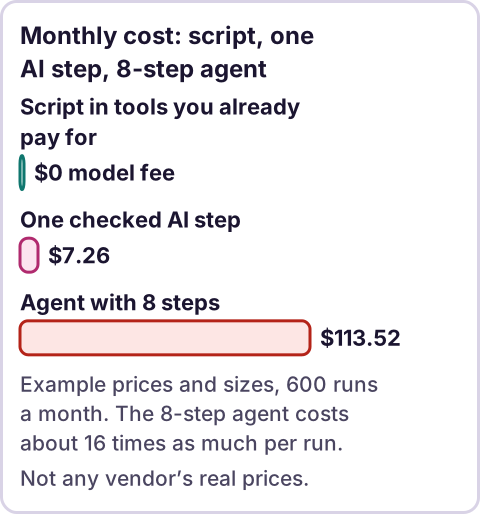
Diagram: Monthly cost: script, one AI step, 8-step agent.
What do you pay for when an AI agent runs?
You pay for tokens. A token is a chunk of text, roughly a short word or part of one. Model providers charge one price per million input tokens and another per million output tokens. In the example below, output costs more than input. Check how your vendor prices each. The input is what you send. The output is what the model writes back.
I could not read a vendor pricing page for this post. My fetch tool declined the pages I tried. So I do not quote any real price. The prices in this post are round numbers I picked to show the math: $2 per million input tokens and $10 per million output tokens. Find your vendor's current prices on its own pricing page and put them in the sheet.
Why does a multi-step agent cost more than one step?
An agent works in a loop. It reads the goal, picks an action, reads the result, and picks the next action. In many setups, each pass sends the whole story so far, plus the new result. So the input grows with each step. How your own agent is built decides whether this is true for it, so check that with whoever built it.
Here is the shape. Say step 1 sends 3,000 tokens and each later step adds 1,500 tokens of results. Then the input is 3,000, 4,500, 6,000 and so on. The total input is not 8 times 3,000. It is larger. That is why the cost grows faster than the number of steps.
How do you calculate the cost per run?
Use five numbers:
- Steps per run (n).
- Input tokens at step 1 (base).
- Tokens added at each later step (added).
- Output tokens per step (out).
- Prices per million input and output tokens.
The formulas:
- Input tokens per run = n × base + added × n × (n − 1) ÷ 2
- Output tokens per run = n × out
- Cost per run = input tokens ÷ 1,000,000 × input price + output tokens ÷ 1,000,000 × output price
- Cost per month = cost per run × runs per month × (1 + share of runs repeated)
The last part covers runs you have to repeat. If 10 percent of runs fail and run again, that adds 10 percent. You have to count your own repeat rate. I have no number for it.
What does the sheet look like?
Make a tab called Agent cost. Put the labels in column A and the numbers in column B, like this:
| Row | A (label) | B (value) |
|---|---|---|
| 1 | Steps per run | 8 |
| 2 | Input tokens at step 1 | 3000 |
| 3 | Tokens added to the input at each later step | 1500 |
| 4 | Output tokens per step | 500 |
| 5 | Input price per million tokens (example) | 2 |
| 6 | Output price per million tokens (example) | 10 |
| 7 | Runs per month | 600 |
| 8 | Share of runs repeated | 0.1 |
| 9 | Input tokens per run | =B1*B2+B3*B1*(B1-1)/2 |
| 10 | Output tokens per run | =B1*B4 |
| 11 | Cost per run | =B9/1000000*B5+B10/1000000*B6 |
| 12 | Cost per month | =B11*B7*(1+B8) |
Rows 1 to 8 are inputs. Change them. Rows 9 to 12 are formulas. Do not type over them.
What does the worked example show?
With the numbers above:
- Input tokens per run: 8 × 3,000 + 1,500 × 8 × 7 ÷ 2 = 24,000 + 42,000 = 66,000
- Output tokens per run: 8 × 500 = 4,000
- Cost per run: 66,000 ÷ 1,000,000 × $2 + 4,000 ÷ 1,000,000 × $10 = $0.132 + $0.04 = $0.172
- Cost per month: $0.172 × 600 × 1.1 = $113.52
Now set steps to 1, which is one checked AI step. The same sheet gives 3,000 input tokens, 500 output tokens, $0.011 per run and $7.26 a month. The 8-step agent costs about 16 times as much per run ($0.172 against $0.011). Those are example prices and made-up sizes. Your real numbers will differ, and the ratio will move with them.
I tested these formulas by building the sheet in Python with openpyxl and recalculating it in LibreOffice. The results matched the hand math above. Nothing was run in Google Sheets.
What does a script cost to run?
A script that runs inside a tool you already pay for has no model fee, because no model runs. The pages I read for this post list Apps Script quotas, not a per-run price, and I found no per-run fee in them. I did not read a full price list, so check Google's current terms. A script still costs time: someone builds it, tests it and fixes it when an input changes. That cost is covered in our cost post.
Where does an LLM fit in this?
An LLM fits where the input is messy and a person checks the result. The sheet shows why that matters for cost as well. One checked step has a small, predictable cost per run. A multi-step agent has a larger cost that depends on how many steps it takes, and you do not control that number. A script around one checked step lets you fix the number of model calls in advance. My stance: AI writes the code, plain automation runs it, and an LLM shows up only where the input is messy and a person checks the result.
What else makes the bill go up?
- More steps than planned. An agent that loops again uses more tokens. Set a step limit.
- Longer inputs. Pasting whole documents costs more than pasting the part you need.
- Repeated runs. A failed run that starts again costs twice.
- Price changes. Vendors change prices and retire models. Check the price page on the day you build.
- Your time. Watching and fixing an agent is a cost the token bill does not show.
Where this has limits
- The prices are examples. I could not read a vendor pricing page for this post. Replace them before you use any number.
- The token sizes are made up. Measure your own job.
- The input growth is an assumption. It holds for agents that send earlier text again at each step. Your agent may differ.
- Some vendors price cached or batched input differently. I did not read their rules, so the sheet ignores this.
- The formulas were tested in LibreOffice only. Nothing was run in Google.
- No ReRev prices and no promises about results.
If you want help deciding whether a job needs a script, one checked AI step or an agent, tell us the job. We sell this work. Do not send keys, passwords or customer data.
Frequently asked questions
How much does it cost to run an AI agent per month?
It depends on the steps per run, the tokens per step, the prices and the runs per month. Use the sheet above with your vendor's current prices.
Why does an agent cost more than one AI call?
Each step usually sends the earlier text again, so the input grows. The total is larger than steps times the first input.
Is a script cheaper than an AI agent?
A script has no model fee. It still costs time to build and maintain. The pages I read list quotas for Apps Script, and I found no per-run fee in them.
Do I need to know how many tokens I use?
You need an estimate. Your vendor may report token counts for a run. Check whether it does. Take a sample of real runs and average them.
What is a token?
A chunk of text, roughly a short word or part of one. Providers bill by the token.
Do prices change?
Yes. Check the vendor's pricing page on the day you build.
Read next: The time audit template finds the hours this cost should be compared against.